The geological contrast between Norwich's western chalk plateau and the eastern river valleys creates two distinct anchoring environments. On the higher ground near the University of East Anglia, the Upper Chalk provides excellent bond capacity for high-load anchors, though solution features and fractured zones demand careful grouting control. Down in the Wensum and Yare floodplains, where much of the city centre sits on alluvium overlying Crag Group sands, anchor design shifts toward passive systems with longer bond lengths in denser strata below the soft surficial deposits. A reliable anchor scheme in Norwich must reconcile these subsurface transitions—what works in Thorpe St Andrew won't necessarily transfer to the hillside sites off Earlham Road. We apply CPT testing to profile the buried channel deposits that cross the city, ensuring the fixed anchor length avoids the compressible peat lenses that historically complicated infrastructure projects along Riverside.
A Norwich anchor is only as reliable as the geological interpretation it is founded on—chalk solution features have voided more than one proof test in this city.
Methodology applied in Norwich
Local geotechnical conditions in Norwich
Norwich's medieval street pattern conceals a legacy of backfilled chalk mines and undocumented cellars that pose direct risks to anchored retaining structures. The city sits above a labyrinth of historic chalk extraction tunnels—particularly beneath the Ber Street and King Street areas—where a high-capacity anchor could daylight into a void without the driller ever seeing it on the surface. Even beyond the known mine extents, the glacially disturbed chalk contains flint bands that deflect drill tooling and produce boreholes deviating from the design alignment by more than a metre over a 15-metre length. Our team has encountered anchor losses on Norwich projects where insufficient site investigation missed a flint nodule bed that steered the drill string off-line, placing the fixed anchor outside the theoretical failure wedge. We now combine rotary percussive drilling with water-flush monitoring to detect sudden losses that signal a cavity or solution pipe before the grout is pumped in.
Our services
Our anchor design service in Norwich spans the full lifecycle from feasibility through construction support, with particular emphasis on the geological conditions specific to the region.
Temporary Active Anchors for Deep Excavations
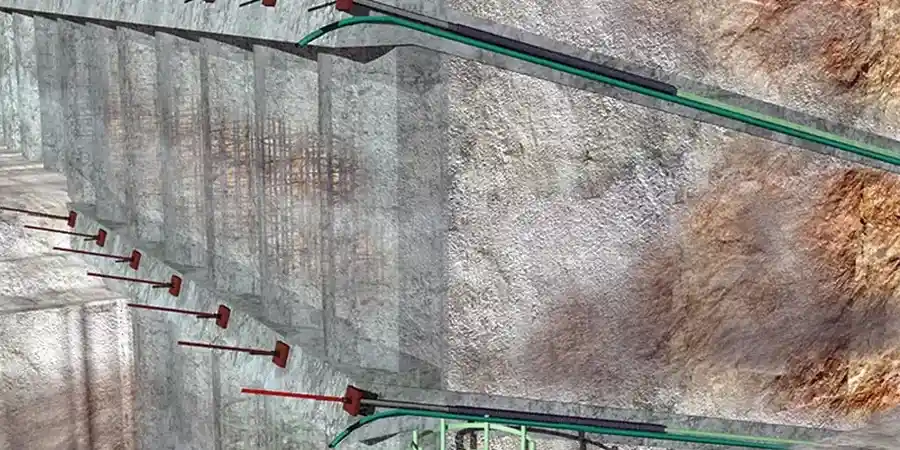
Strand anchors installed through Crag sand into competent chalk for basement and cut-and-cover projects in Norwich city centre, with staged stressing monitored against the serviceability limit state.
Permanent Passive Anchors for Retaining Structures
Double-corrosion-protected bar or strand anchors designed for 120-year service life in chalk and alluvial environments, typically for highway cuttings along the A47 corridor.
Anchor Proof Testing and Suitability Assessment
On-site tensioning to BS 8081 investigation and production test schedules, including extended creep monitoring in putty chalk zones where time-dependent deformation is a known concern.
Design Review of Existing Anchor Systems
Re-evaluation of legacy anchored walls in Norwich where groundwater conditions have changed, incorporating updated geological models and current partial factor approaches from Eurocode 7.
Questions and answers
What is the difference between active and passive anchors in retaining wall design?
Active anchors are tensioned after installation to apply a predefined load that restrains the wall, reducing lateral movement from the outset. Passive anchors are not prestressed; they mobilise resistance only as the wall deflects and the ground begins to move. In Norwich practice, active anchors dominate for deep basement excavations in the city centre where adjacent historic buildings impose tight deflection limits, while passive systems—often rock dowels into chalk—suit cuttings where some controlled displacement is acceptable.
How much does an anchor design package cost for a Norwich project?
For a typical retaining wall project in Norwich requiring anchor design to BS 8081 and Eurocode 7, the engineering fee ranges from £810 to £2,570 depending on the number of anchor types, the complexity of the ground model, and the required testing specifications. A straightforward scheme with one anchor type and standard proof testing falls at the lower end; multi-level anchored walls in variable chalk conditions with investigation testing programmes reach the upper range.
Which British Standards govern ground anchor design and testing?
BS 8081:2015 is the primary code of practice for grouted anchors in the UK, covering design, materials, installation, and testing. It works alongside BS EN 1997-1:2004 (Eurocode 7 Part 1) for geotechnical limit state design and BS EN 1537:2013 for execution requirements. BS 5930:2015 provides the ground investigation framework that underpins the anchor bond stress values. For anchors forming part of a highway structure, additional requirements from the Design Manual for Roads and Bridges may apply.