Norwich’s urban fabric, stretching from the medieval core around the castle mound down to the River Wensum floodplain, has always been a story of building on challenging ground. The city sits on a geological patchwork of Cretaceous Upper Chalk overlain by variable thicknesses of Crag Group sands and gravels, with pockets of glacial till and post-glacial alluvium along the river valleys. When the Victorians expanded the city northwards, they encountered the compressible, soft silts of the floodplain and had to adapt their foundations accordingly. Today, our laboratory team sees the same need for reliable subsurface data, which is why we offer SPT (Standard Penetration Test) activities that give a direct measure of soil density and consistency. The standard penetration test remains the most practical method to quantify ground variability in Norwich’s mixed geology, where a site can transition from dense chalky gravel to soft silt within a few metres. For deeper investigations in these transitions, we often combine the SPT with a CPT test to get a continuous profile without sample disturbance, ensuring no weak layer is missed before design begins.
An uncorrected SPT N-value in Norwich’s Crag sands can overestimate bearing capacity by 30% if gravel content isn’t properly logged during drilling.
Methodology applied in Norwich
Local geotechnical conditions in Norwich
Norwich sits just 10 metres above sea level on average, and the River Wensum’s historical floodplain extends under parts of the city centre and postcodes NR1 and NR3, where soft, normally consolidated alluvium can produce SPT N-values as low as 2 to 4. Building on such ground without adequate investigation carries a real risk of differential settlement, particularly where older adjacent structures bear on shallow footings in denser terrace gravels. We have seen projects where a single borehole without SPT sampling missed a buried paleochannel filled with peat and organic silts, resulting in a foundation redesign halfway through construction. The standard penetration test allows us to identify these soft spots early and recommend deeper foundations or ground improvement, such as stone columns, which can densify the silty sands and transfer load to more competent strata. Ignoring the lateral variability of the Crag Group deposits, which can shift from dense sands to weakly cemented sandstone within the same site, is a gamble that no structural engineer in Norwich should take.
Our services
Our SPT service in Norwich is part of a broader ground investigation capability that takes the project from initial drilling right through to final reporting. We manage the entire process with our own rigs and laboratory, so you get a single, coherent dataset without subcontractor delays.
Borehole Drilling and SPT Execution
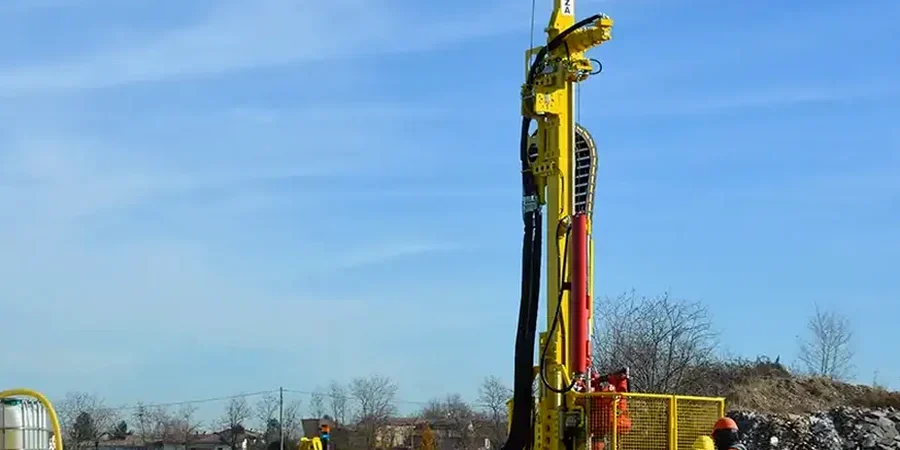
We mobilise a tracked drilling rig to your Norwich site and perform SPTs at 1.5 m intervals or at every stratum change, with strict adherence to the BS EN ISO 22476-3 procedure. Each test includes split-spoon recovery, blow count logging, and immediate sample transfer to our laboratory for description.
UKAS-Accredited Laboratory Testing
Disturbed SPT samples undergo particle size distribution, Atterberg limits, and moisture content determination in our Norwich laboratory. We correlate the index properties with the field N-values to produce a reliable ground model and derive design parameters for your foundation engineer.
Factual and Interpretative Reporting
We deliver a comprehensive ground investigation report containing borehole logs with SPT N-values, core photographs, laboratory test results, and a geotechnical interpretation of bearing capacity, settlement potential, and any ground improvement recommendations tailored to Norwich’s geology.
Questions and answers
What is the typical cost of an SPT borehole investigation in Norwich?
In the Norwich area, a standard SPT borehole investigation typically ranges from £400 to £650 per borehole, depending on depth, access constraints, and the number of tests required. The final cost includes the drilling crew, the SPT execution, sample transport to our laboratory, basic classification testing, and the production of a factual report. Sites with restricted access, such as terraced streets in the Golden Triangle, may require a smaller rig and additional time, which can affect the price. We offer a fixed quotation after a site visit so there are no surprises.
How many SPTs do I need for my Norwich building plot?
The number of SPTs depends on the site size and geology, but BS 5930 recommends a minimum of one borehole with SPT sampling for small structures, and a grid of boreholes for larger developments. In Norwich, where the Crag Group and alluvium can vary sharply, we typically advise at least two to three boreholes to capture the lateral variability and avoid missing soft pockets or solution features in the chalk. Our team can propose an exploration plan that satisfies both your budget and the requirements of your building control officer.
How long does an SPT investigation take from start to report delivery?
For a typical residential project in Norwich, field work including mobilisation, drilling, and SPT sampling usually takes one to two days. Our laboratory processing of the samples for classification and moisture content adds three to five working days. The final factual report, complete with borehole logs and N-value profiles, is generally delivered within ten working days of completing the field work, though we can offer an express service for urgent foundation design decisions.
Can SPT testing identify the risk of chalk dissolution features under my site?
While the SPT itself measures soil density and consistency, a sudden drop in N-values followed by rod drop or drilling break can indicate a void or soft infill within the chalk, which is a known hazard in parts of Norwich. We combine the SPT data with careful observation of drilling behaviour, water loss, and sample inspection to flag potential dissolution features. For a more detailed picture, we may recommend supplementing the SPT with rotary coring or geophysical methods to delineate the extent of any anomaly before foundation design proceeds.