When you work in Norwich, you learn quickly that the ground beneath your feet can change within a matter of metres: the city sits on a geological boundary between chalk of the Upper Cretaceous period and the overlying Crag deposits and alluvial silts of the River Wensum valley. We have seen tunnel projects where the face conditions shifted from competent Norwich Chalk into water-charged silty sands in the space of a single advance, and that transition is precisely where poorly informed decisions cost serious time and money. Our approach to soft ground tunnelling analysis starts with a rigorous desk study of the British Geological Survey mapping for the TG postcode area, then layers on targeted intrusive investigation to build a ground model that holds up under the scrutiny of an independent checker under BS EN 1997-1:2004.
In Norwich's mixed-face conditions, the difference between a successful tunnel drive and a costly standstill often comes down to whether the ground model correctly predicted the chalk-to-Crag transition zone.
Methodology applied in Norwich
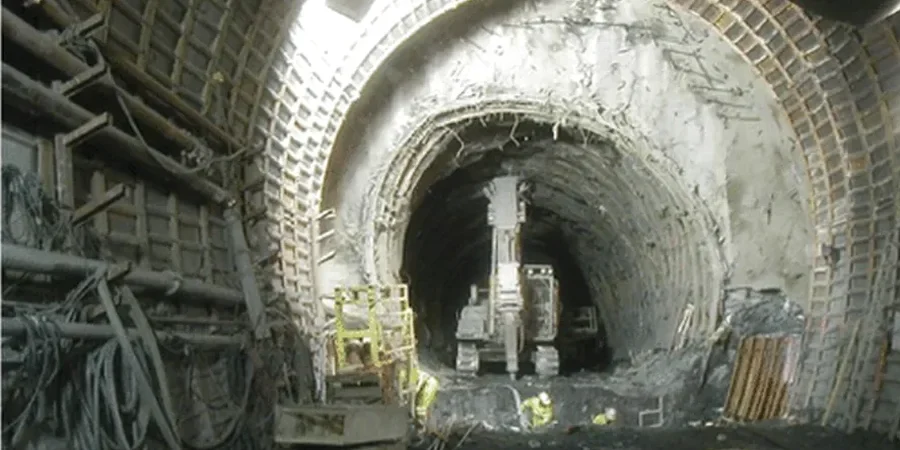
Local geotechnical conditions in Norwich
The kit that makes a genuine difference on a Norwich soft ground investigation is the high-pressure dilatometer deployed inside a cased borehole: it lets you measure the in-situ stiffness of the chalk without the sample disturbance that plagues laboratory UCS tests on this sensitive material. We run the dilatometer in 1-metre increments through the proposed tunnel horizon, and the modulus profile it generates feeds directly into the convergence-confinement analysis that predicts how quickly the face will close after each excavation stage. A second piece of equipment that we specify more often than not is the self-boring pressuremeter for the Crag sands, because even the best wireline piston sampling tends to densify these deposits, and a pressuremeter test gives you a direct measurement of the horizontal stress state that governs ground arching above a shallow tunnel crown in Norwich's urban environment.
Our services
Our Norwich-based investigations are structured to deliver the specific parameters that tunnel designers need for a solid settlement assessment and face stability calculation under UK practice:
Norwich Chalk characterisation
Detailed logging of chalk structure grades (I through V per Mundford classification) with point load index testing and laboratory UCS on selected specimens to feed into rock mass classification systems used for TBM selection.
Pore pressure monitoring for tunnel alignment
Installation of standpipe and vibrating wire piezometers along the tunnel horizon to capture seasonal groundwater fluctuation in the Wensum valley, critical for effective stress analysis of face stability during winter months.
Soil-structure interaction parameters
Determination of small-strain stiffness (Gmax) through bender element testing on undisturbed Crag and alluvium samples, providing the input for advanced FE models that predict surface settlement troughs under listed buildings in central Norwich.
Face stability and wedge analysis
Limit equilibrium and numerical modelling of tunnel face conditions using the measured strength and pore pressure data, with explicit consideration of the mixed chalk-Crag interfaces that characterise Norwich's shallow bedrock topography.
Questions and answers
What makes Norwich ground conditions challenging for soft ground tunnelling?
The main challenge is the rapid transition between the competent Norwich Chalk and the overlying Crag sands and Wensum alluvium. A tunnel drive can encounter structured chalk with a stand-up time of several hours, then hit a water-bearing sand lens within the same shift. The chalk itself also degrades with depth into a structureless material that behaves more like a stiff clay, which means the face pressure required for stability changes significantly along the alignment.
What investigation techniques do you use for tunnel design in Norwich?
We combine cable percussion and rotary core drilling with in-situ pressuremeter and dilatometer testing. For the Crag and alluvium we use self-boring pressuremeters to measure horizontal stress, and in the chalk we run high-pressure dilatometers to capture the stiffness profile without sample disturbance. All testing is backed by our UKAS-accredited laboratory for triaxial, oedometer and index testing to BS 5930 and Eurocode 7 standards.
How much does a geotechnical site investigation for a tunnel in Norwich cost?
The cost for a tunnel investigation in Norwich typically ranges from £3,370 to £13,740 depending on the depth of the tunnel, the number of boreholes required, and the complexity of the in-situ testing programme. A short pedestrian tunnel at shallow depth with two boreholes sits at the lower end, while a longer alignment with multiple investigation points, pressuremeter testing and a full laboratory suite moves toward the upper range.
Do you handle the settlement assessment for nearby structures?
Yes, settlement analysis is a core part of our tunnel investigation scope. We generate the stiffness and strength parameters needed for finite element or empirical settlement trough prediction, and we can install surface settlement markers and precise levelling points on buildings within the zone of influence. This data feeds directly into the Environmental Statement and the detailed design risk register.
How long does a tunnel ground investigation take in Norwich?
A typical investigation for a soft ground tunnel in Norwich takes between four and eight weeks from mobilisation to the delivery of the GIR and GDR. This includes drilling, in-situ testing, piezometer installation, laboratory testing and the geotechnical interpretation. The programme depends on the length of the alignment and the number of investigation positions, but we can accelerate turnaround with interim factual reporting when the design team needs early data for concept decisions.