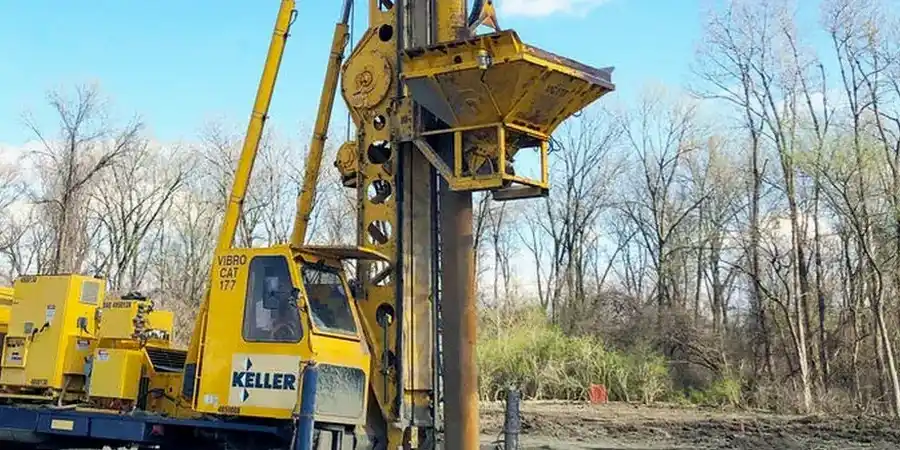
The deep vibrator is a long, cylindrical probe with eccentric weights inside, powered electrically or hydraulically, and suspended from a crawler crane. When it penetrates loose granular soil in the Norwich area, the horizontal vibrations rearrange the particle structure into a denser state, creating a compacted column of treated ground around each insertion point. The chalk bedrock beneath the city’s eastern suburbs lies at highly variable depths, often overlain by river terrace gravels and softer alluvium from the River Wensum—making ground treatment essential before placing foundations. The team tailors the grid spacing and vibration duration to achieve the target relative density, interpreting real-time ammeter readings from the rig to verify compaction energy. In zones where the natural gravels are too thin, a stone column top-feed system adds granular material from the surface to compensate for the volume reduction, ensuring uniform bearing capacity across the site.
Real-time ammeter monitoring during vibrocompaction gives the engineer a direct window into the soil’s densification—no waiting for lab results to confirm refusal.
Methodology applied in Norwich
Local geotechnical conditions in Norwich
A common mistake on Norwich’s former industrial plots is to assume that vibrocompaction can treat any fill without a proper fines content check. Sites along the Riverside regeneration area often contain old brick rubble mixed with clay-rich demolition waste; when the fines exceed 15%, the vibrator simply remoulds the soil without densifying it, leaving hidden soft spots under the slab. Six months later, differential settlement cracks appear in the partition walls. A simple wash-sieving test on the fill before design avoids this, and the correct specification might switch to a stone column solution on those pockets, keeping the rest of the site on a vibro grid.
Our services
realizamos un portafolio completo de tareas técnicos de diseño de vibrocompactación diseñados para proyectos de construcción, minería e infraestructura en Norwich.
Vibrocompaction Trial Design and Specification
We prepare the treatment specification including vibrator type, grid geometry, target amperage, and backfill gradation, all referenced to the BS EN 14731 execution standard. The trial panel report defines the operational parameters for the main works.
Post-Treatment Verification and Reporting
Using CPT rigs and settlement plates, we compare pre- and post-compaction ground conditions to confirm the design assumptions. The verification report provides the improved geotechnical parameters for the structural engineer’s foundation design.
Questions and answers
How much does vibrocompaction design cost in Norwich?
Design fees for vibrocompaction in the Norwich area typically range from £1,200 to £3,710 depending on the treated footprint, the number of compaction points, and the depth of the loose layer. A smaller residential plot on river gravels will sit at the lower end, while a commercial site with deep made ground and extensive CPT verification will increase the engineering time and the final fee.
What soil types in Norwich are suitable for vibrocompaction?
The technique works best on granular soils with less than 12% fines: the river terrace gravels along the Wensum valley, the Crag Group sands found beneath the city centre, and clean quarry backfill. It is not suitable for the soft, organic silts of the floodplain or the chalk putty zones, which require alternative ground improvement such as stone columns.
How is the design verified after treatment?
Verification follows the BS EN 1997-2 framework using a combination of pre- and post-treatment CPT soundings, zone load tests on a plate, and surface settlement monitoring. At least one CPT per 200 m² of treated area is typical, with the acceptance criterion based on achieving the target cone resistance profile specified in the design report.