Norwich sits on a complex mix of Cretaceous chalk, Crag sands, and deep alluvial silts in the river valleys. The 1960s expansion across the Yare floodplain pushed foundations into some of the softest soils in East Anglia. Grain size analysis is the first concrete number we get on any project here. It tells us whether we are dealing with a freely draining sand or a moisture-sensitive silt that will hold water against a foundation for months. The city’s geology shifts fast—within 200 metres you can move from chalk till to laminated silts—so particle size distribution is not a formality. It is the base layer for every bearing capacity calculation and drainage design we produce. In the Wensum corridor, where historic quayside structures sit on made ground, we often pair the test pits log with a full sieve suite to separate natural sediment from brick rubble and organics before any foundation decision.
A single gradation curve replaces assumptions with numbers—and in Norwich silts, assumptions are expensive.
Methodology applied in Norwich
Local geotechnical conditions in Norwich
A contractor on a warehouse project off the A140 stripped the topsoil and found clean-looking sand. They placed the pad footings at 1.2 m depth without a grain size test. Six months later, the slab joints were opening. The sand had 18% fines content that never showed up in a hand-auger log. It was silty sand, not clean sand, and it had consolidated unevenly under cyclic loading from forklifts. A simple sieve and hydrometer before the pour would have flagged the fines and pushed the bearing capacity down by 30%. Remediation cost ran to £40k. In Norwich’s river terrace deposits, fines content is the hidden variable. We never sign off a foundation without the full gradation curve, because what looks like sand in the field can behave like silt in the lab.
Our services
Every grain size report we issue from the Norwich lab includes the full semi-log plot, the D-values, and a classification to BS 5930. The three core procedures we run daily:
Full Sieve Analysis (coarse)
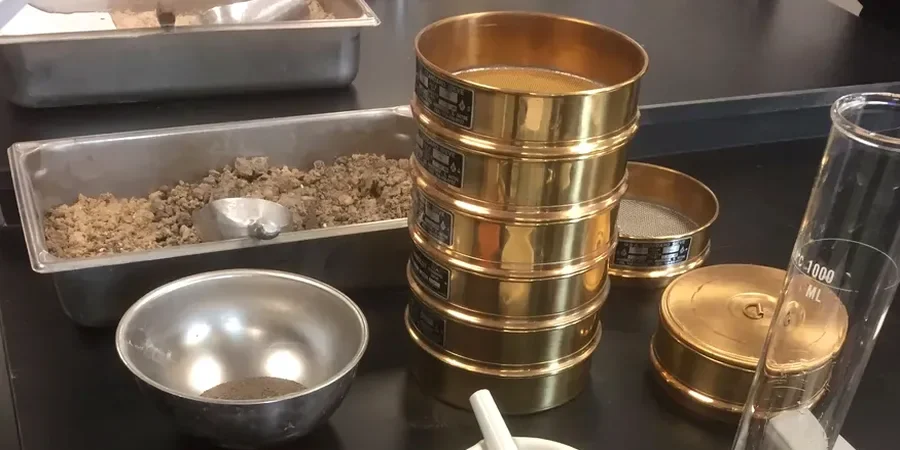
Mechanical shaking through 200 mm sieves, 75 mm down to 63 microns. Wash-through of fines included. Suitable for sands and gravels across Norfolk.
Hydrometer Sedimentation (fine)
151H hydrometer method per BS 1377-2. Covers silt and clay fractions from 63 microns down to 2 microns. Essential for alluvial soils in the Yare and Wensum valleys.
Combined Sieve + Hydrometer (full curve)
The complete particle size distribution. Used for all foundation designs and earthworks specifications where fines content governs behaviour.
Questions and answers
How much sample do you need for a grain size test?
For coarse soils we need about 5 kg. For fine silts and clays, 200 g is enough. If you are not sure, bring us a 2 kg sealed bag and we will split it in the lab. The sample must be representative and kept at natural moisture until delivery.
What does a grain size analysis cost in Norwich?
A standard sieve analysis runs £70–£90. The combined sieve and hydrometer test is £120–£160, depending on how many hydrometer points are needed. We quote same-day by email once we see the sample quantity and turnaround requirements.
How quickly can I get results?
Sieve-only results are usually ready in 48 hours. The full hydrometer test takes 5 working days because of the 24-hour sedimentation readings. We can fast-track sieve results to 24 hours for urgent foundation decisions.
Do I need the hydrometer if my soil looks like sand?
Yes, if the sand feels silty to the touch. Norwich river terrace sands often carry 10–20% fines that you cannot see by eye. Those fines control drainage and frost heave. Skipping the hydrometer on a borderline sand is the most common mistake we see on local projects.