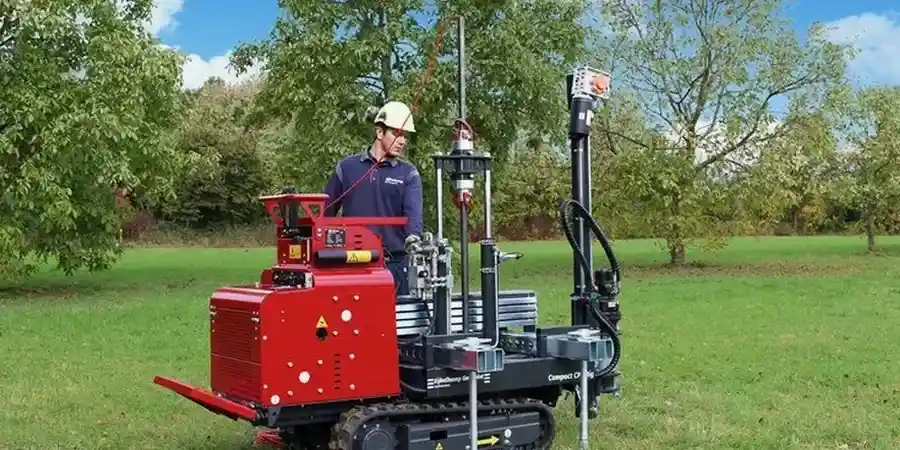
The glacial tills and alluvial silts of the River Wensum valley make Norwich a tricky place to rely on boreholes alone. We run CPT rigs here weekly and see it firsthand — a dense chalk layer at 8 metres, then soft peat pockets near the Yare floodplain. Standard SPT can miss these transitions. This is why our CPT testing provides a continuous resistance trace, mapping cone tip resistance and sleeve friction every centimetre. The East Anglian climate adds another layer: high winter groundwater softens the near-surface silts, changing bearing response between seasons. We use 20-tonne tracked rigs that access tight city-centre sites and the expanding suburbs around Longwater and Broadland. The data feeds directly into foundation models, saving clients the cost of over-designing for phantom weak layers or under-estimating real ones.
CPT gives us a 10-centimetre resolution profile. Boreholes give you a point every metre and a half. On Norwich's mixed glacial deposits, that resolution changes the foundation decision.
Methodology applied in Norwich
Local geotechnical conditions in Norwich
BS EN 1997-2 requires ground investigation to be planned so that soil layering is established with sufficient continuity. In Norwich, ignoring this requirement carries specific risks. The city sits on a patchwork of Lowestoft Till, chalk, and river terrace deposits. Two CPTs 15 metres apart can return completely different refusal depths. We have seen sites where one cone hits chalk at 6 metres and the neighbouring push reaches 18 metres before refusal — a buried channel feature typical of Anglian glaciation. Designing foundations without mapping this variability leads to differential settlement. The second risk is liquefaction assessment. Although Norwich is not in a high-seismicity zone, the silty sands along the Wensum corridor can be susceptible. CPT-based methods by Seed and Idriss (1971) and updated by Robertson (2009) remain the standard for evaluating this. A third risk is time: soft clays show consolidation effects that only piezocone dissipation tests can quantify. Skipping CPT means guessing the settlement timeline.
Our services
Our Norwich CPT service covers the full workflow from site access planning to final report. We operate across Norfolk and into Suffolk, handling inner-city sites, agricultural land, and floodplain projects.
CPTu with Pore Pressure Dissipation
Piezocone testing that records excess pore pressure during penetration and dissipation after stops. Essential for estimating consolidation rates in Norwich's soft alluvial clays. We use u2-position transducers and log at 10 mm intervals.
Seismic CPT for Shear Wave Velocity
Adds a downhole geophone to the standard cone string. Measures Vs profiles for small-strain stiffness and earthquake site classification without drilling a separate borehole. Useful for basement excavation models in the city centre.
CPT Data Correlation and Foundation Reports
We process raw cone data through soil behaviour type charts (Robertson, 1990) and produce parameter sets for shallow and deep foundation design. Reports include qc-N60 correlations, undrained shear strength estimates, and settlement calculations.
Questions and answers
What is the typical cost of a CPT test in Norwich?
For a standard CPTu push to 15–20 metres depth within the Norwich area, the cost ranges from £150 to £210 per test point. The final rate depends on access conditions, total metres pushed, and whether you need seismic or dissipation modules added. We offer a fixed price before mobilisation.
How deep can the CPT rig push in Norfolk soils?
Our 20-tonne rig reaches up to 25 metres in soft to medium-stiff ground. However, in Norwich we often hit chalk refusal much sooner — typically between 8 and 20 metres depending on the site. We monitor cone stress and stop when refusal criteria are met to protect the cone and rods.
Do I need a borehole if I already have CPT data?
CPT provides continuous resistance and pore pressure data but does not recover soil samples. For projects where soil classification must be verified by laboratory testing — Atterberg limits, triaxial tests — we recommend at least one borehole paired with the CPT. The two methods are complementary. CPT tells you the profile; the borehole confirms the lithology.
What is the difference between CPT and SPT drilling?
CPT pushes an instrumented cone continuously into the ground and records tip resistance (qc), sleeve friction (fs), and pore pressure (u2) every centimetre. SPT drilling recovers disturbed samples at 1.5-metre intervals and measures blow counts. CPT is faster, cleaner, and gives higher-resolution profiles, but SPT is better for obtaining samples for lab testing. Many Norwich projects use both techniques together.