Compaction control is non-negotiable under UK practice. BS 5930:2015+A1:2020 and BS EN 1997-2 require verification that placed fill meets the design specification. In Norwich, this matters more than many realise. The city sits on a mix of glacial tills, river terrace gravels, and the chalk bedrock of the Wensum valley. These materials respond differently to compaction. A uniform pass count from a roller guarantees nothing if you don’t test. The sand cone method remains the most practical field check for density on residential plots, commercial pads, and highway subgrade. Our work across Norwich confirms that getting the moisture content right in the local chalky boulder clay is the difference between a failed test and a pass. We pair this with CBR testing for roads when the project moves from earthworks to pavement design.
A sand cone test in Norwich chalk till tells you more about real compaction than 100 passes of a vibrating roller ever will.
Methodology applied in Norwich
Local geotechnical conditions in Norwich
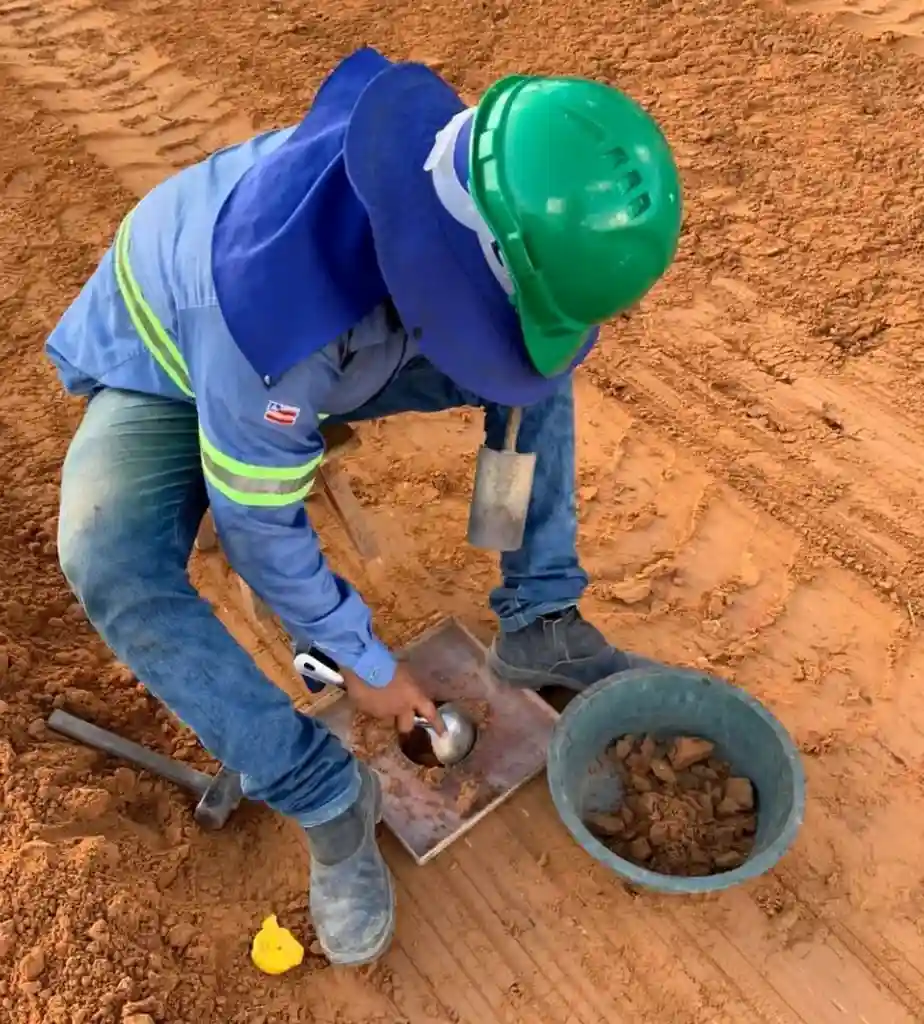
The kit is simple: a sand cone jar, a base plate, a digging tool, and a bag of calibrated sand. Nothing digital. That simplicity is its strength. But the biggest risk in Norwich is water. The Wensum floodplain and the marshland east of the city produce soils that sit close to saturation. A density test run on fill that’s too wet will give a misleadingly high dry density because the soil compacts under the weight of the sand pouring device. We see it on sites near Whitlingham Broad. Operators who don’t recognise this end up accepting weak fill that later settles. The other risk is coarse chalk fragments. If the test hole hits a chunk larger than 37.5 mm, the volume measurement loses accuracy. Our technicians carry a spare plate and move the test location when that happens. It’s a small decision with large consequences for foundation performance.
Our services
We deliver field density control from the first lift of engineered fill to the final subgrade proof roll. Each project in Norwich gets a programme tailored to the soil type and the specification.
Compaction verification for residential plots
Testing on individual housing plots across NR1 to NR8 postcodes, with reports formatted for NHBC or local building control acceptance. We cover footings trenches, floor slab subgrade, and driveway approaches.
Highway and commercial earthworks control
Layer-by-layer density testing on commercial building pads and road subgrade per Series 600 of the Specification for Highway Works. We coordinate with the contractor’s compaction plant to optimise passes and moisture conditioning.
Questions and answers
What does a field density test cost on a typical Norwich residential site?
For a standard visit within the Norwich urban area, the cost ranges between £90 and £100 per test point. That includes the sand cone measurement, moisture content determination, and a signed report with relative compaction calculations. The number of points depends on the fill area and lift thickness; we help you work out the minimum needed to satisfy Series 600 or your engineer’s specification.
How does the sand cone method compare to a nuclear density gauge?
The sand cone method is a direct volumetric measurement. You dig the soil, weigh it, measure the hole volume with sand, and calculate density. A nuclear gauge infers density from radiation backscatter. On Norwich’s chalky boulder clay, the sand cone often gives a more reliable result because the gauge can be influenced by the variable chemistry of the chalk. The trade-off is time: a sand cone takes 20 minutes, a gauge takes two. But for proof-roll acceptance, the direct method carries more weight with engineers.
How soon after compaction can you test the fill?
We test immediately after the roller has passed and the surface is firm enough to walk on without leaving deep footprints. There is no curing period. The key is that the soil moisture content must be within the specified range at the time of compaction. If rain has fallen between lifts, we check the surface moisture first and may delay the test until the ground drains back to an acceptable state.