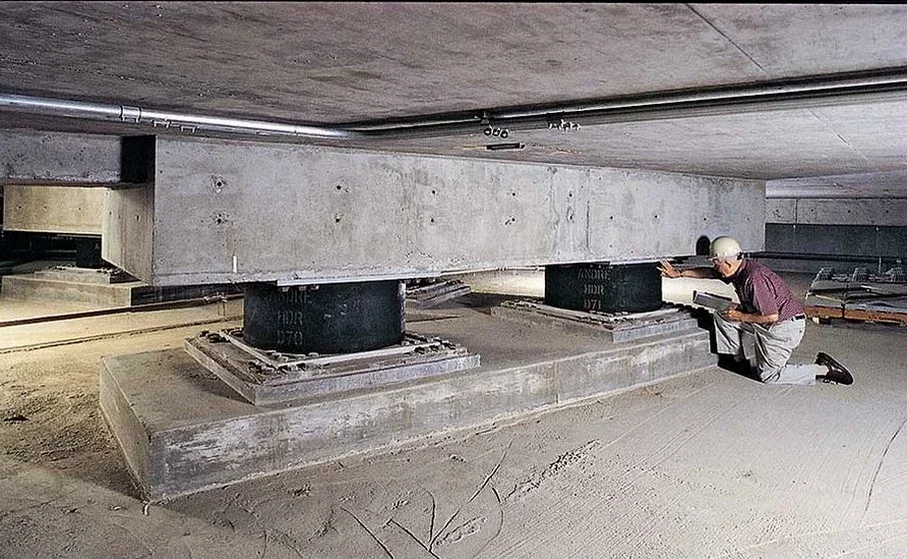
The structural demands shift dramatically between Norwich's historic city centre and the modern developments near the University of East Anglia. In the medieval core, shallow foundations often bear directly onto the Upper Chalk, while just a few hundred metres east, the River Wensum's floodplain introduces compressible alluvium and peat lenses. This abrupt transition in ground stiffness amplifies seismic demand differently across a single site. Base isolation seismic design addresses this by decoupling the superstructure from ground motion—critical when one half of a building sits on rock and the other on soft soil. We apply site-specific response spectra derived from borehole shear-wave velocity profiles, not generic assumptions. For sites with deep soft layers, integrating a CPT test refines the soil classification and liquefaction potential before isolator properties are finalised.
A base-isolated structure in Norwich must accommodate the stark stiffness contrast between chalk and floodplain soils within a single isolation plane.
Methodology applied in Norwich
Local geotechnical conditions in Norwich
The East Anglian climate introduces a factor rarely discussed in isolation design: long-term moisture ingress into the isolation interface. Norwich averages over 650 mm of rainfall annually, and the water table in the river valley sits within two metres of the surface for much of the year. A retrofit isolation project on a masonry structure from the 1920s faced exactly this—the original plinth was permanently damp, and any isolation bearing would need a drained, inspectable moat to prevent corrosion and biodeterioration of the elastomer. We specified marine-grade stainless steel shim plates and a positive drainage system with sump pumps on float switches. The design also accounted for thermal movement of the moat covers, which in a Norwich winter cycle can exceed 30°C differential. Overlooking moisture management in the isolation plane means the bearings lose their mechanical properties within a decade, well short of the 50-year service life required by the UK National Annex to EN 15129.
Our services
Our base isolation design package covers the full workflow from site characterisation through to construction-phase testing. Every project is led by a chartered engineer with direct knowledge on UK seismic projects.
Site-specific response spectrum development
We derive the elastic response spectrum from borehole geophysics, downhole Vs profiles, and laboratory dynamic testing of intact specimens. The ground model accounts for Norwich's chalk-till-alluvium sequences and basin edge effects.
Isolator specification and prototype testing
Bearing design to BS EN 15129 including full-scale shear testing at our UKAS-accredited facility. We verify horizontal stiffness, damping, and low-temperature performance relevant to East Anglian winter conditions.
Questions and answers
What does base isolation seismic design cost for a typical project in Norwich?
For a small to mid-rise commercial building, the design and testing package typically falls between £3,590 and £5,700, depending on the number of bearing types, the complexity of the ground model, and the required prototype test programme.
How does the chalk geology affect base isolation design?
The Upper Chalk beneath Norwich is stiff but can contain dissolution features and variable weathering grades. We characterise the chalk mass stiffness through geophysics and borehole testing, then model the kinematic interaction between the chalk profile and the isolation system to ensure the design spectrum is not unconservative.
What is the minimum scope of ground investigation needed?
As a minimum, we require boreholes with SPT N-values, downhole Vs measurements, and laboratory index testing. For sites near the Wensum, CPT soundings are strongly recommended to capture the soft alluvium and peat layers that govern the long-period response.
Can existing buildings in Norwich be retrofitted with base isolation?
Yes, though it is more demanding than new-build isolation. The structure must be temporarily supported while the isolation plane is inserted, typically at ground floor level. We have applied this to masonry and reinforced concrete frames in the region, with careful phasing to maintain occupancy where possible.
How long does the design and testing process take?
A complete package—from ground investigation through to approved isolator fabrication drawings—usually takes 10 to 14 weeks. Prototype testing adds approximately four weeks, depending on the loading protocol and any retesting cycles.