Norwich’s development from a medieval wool hub to a modern regional capital has left a fascinating legacy beneath our feet. The city centre sits on a river terrace of the Wensum, but push out towards the suburbs and you quickly encounter the chalky boulder clay that defines so much of Norfolk. In our knowledge, this geological patchwork means you can't rely on textbook assumptions for ground behaviour. A standard site investigation gives you a picture, but when you're designing a deep basement in the city centre, or an embankment on the outskirts, you need the actual failure envelope of the soil. That's where the triaxial test comes in. It's not just a tick-box exercise for the building control officer; for us, it’s the most honest conversation you can have with the ground before you commit to a design. We often pair it with in-situ permeability testing to understand how water pressure will interact with the soil's strength, which is a common challenge given the groundwater conditions in the Yare and Wensum valleys.
A consolidated-undrained triaxial test with pore pressure measurement often reveals a much higher effective strength in Norwich's boulder clay than undrained tests alone suggest.
Methodology applied in Norwich
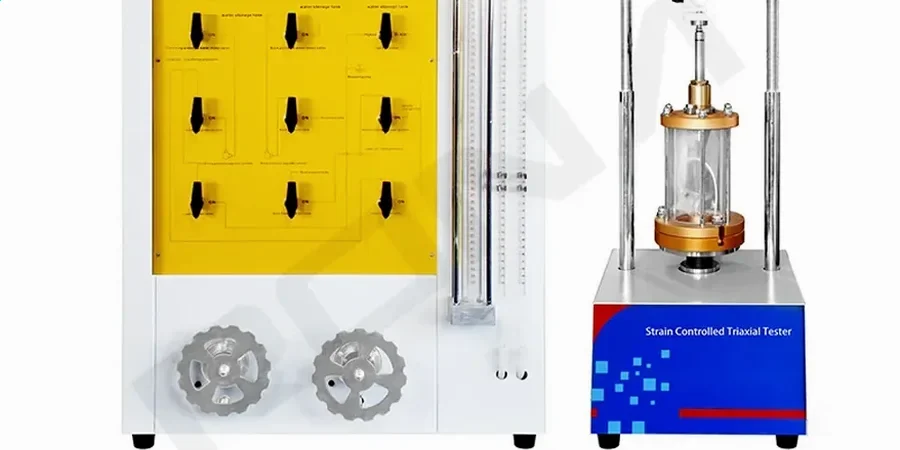
Local geotechnical conditions in Norwich
The geology around Norwich is dominated by the Lowestoft Formation, a chalky, sandy clay till that can be deceptively variable. We've seen two boreholes just five metres apart produce soil with completely different gravel-sized chalk content, which massively affects the shear strength. The biggest risk we see isn't a catastrophic collapse during the test, but rather a misinterpretation of the data. If you fail to saturate the sample properly, or don't use a loading rate slow enough to allow pore pressure equalisation in a silty clay, you'll get a friction angle that's too low. This leads to an over-designed, costly foundation, or worse, an unconservative slope design. The presence of water-bearing sand lenses within the till is a common feature in Norwich, and these can create localised pore pressure spikes during shearing that a poorly instrumented test would completely miss. Our lab is configured to back-saturate samples to achieve a Skempton's B-value of at least 0.95, which is non-negotiable for getting reliable effective stress parameters in these soils.
Our services
When you work with us on a triaxial testing programme, you're not just hiring a lab; you're getting a team that understands the ground conditions from the Norfolk coast to the Broads. We manage the whole process, from sample extrusion to final report, ensuring the results are directly applicable to your design challenge in Norwich.
Multi-Stage Triaxial Testing for Norwich Sites
For sites where recovery of multiple identical samples is difficult, such as in the fractured chalk or layered silts of the Wensum Valley, we perform a multi-stage triaxial test on a single specimen. This approach allows us to define the Mohr-Coulomb failure envelope from one high-quality sample by shearing it at progressively higher confining pressures, which is a practical and cost-effective way to get critical design parameters.
Advanced Stress Path Testing
For major infrastructure or complex basement excavations in Norwich, we can run stress path triaxial tests that simulate the actual loading and unloading sequence of your construction. By following a specific total stress path (such as a K0 consolidation followed by lateral extension), we offer soil stiffness values (E') that are far more representative than standard moduli, allowing for precise prediction of ground movements.
Questions and answers
What type of triaxial test do I need for a foundation design in Norwich's boulder clay?
For most shallow and deep foundation designs in the stiff, over-consolidated boulder clay common around Norwich, we recommend a consolidated-undrained (CU) triaxial test with pore pressure measurement. This gives you the effective stress parameters (c' and φ') required for long-term drained analysis, which is the critical case for many structures on these soils. For rapid loading scenarios during construction, the same test provides the undrained shear strength (Su).
How long does a typical triaxial test programme take?
A standard single-stage CU triaxial test in our lab typically takes between 5 and 7 working days from sample setup to report. This includes time for back-saturation, consolidation, and the shearing stage at a slow, controlled rate to ensure accurate pore pressure response. A multi-stage test or a drained (CD) test on a low-permeability soil will require a longer period, which we can scope out during an initial conversation.
Can you test granular materials like the sands found along the River Yare?
Yes, we routinely test granular, cohesionless soils, including the river terrace sands and gravels found along the River Yare. The key is obtaining an undisturbed sample, which is difficult with a standard sampler. We often recommend using a piston sampler or block sampling, and then we can perform a drained (CD) triaxial test to determine the friction angle accurately, which is critical for the design of retaining walls and bridge abutments.
What is the typical cost for a triaxial test programme for a project in Norwich?
The cost of a triaxial test programme in Norwich depends heavily on the number of tests and their type, but for a typical site investigation requiring a set of three CU tests on 100mm samples, the fee would generally fall within the range of £1.690 to £2.320. This includes sample preparation, saturation, consolidation, shearing, and a full factual and interpretive report.
How do I prepare and transport soil samples to your lab for a triaxial test?
Sample disturbance is the single biggest source of error in a triaxial test. We can offer detailed instructions and sampling tubes, but the golden rule is to minimise vibration and moisture loss. Samples from Norwich sites should be wrapped in cling film and wax immediately after extrusion, placed in a rigid, padded container, and kept upright. They should be transported to us the same day, or kept in a cool, humid store, never in direct sunlight.